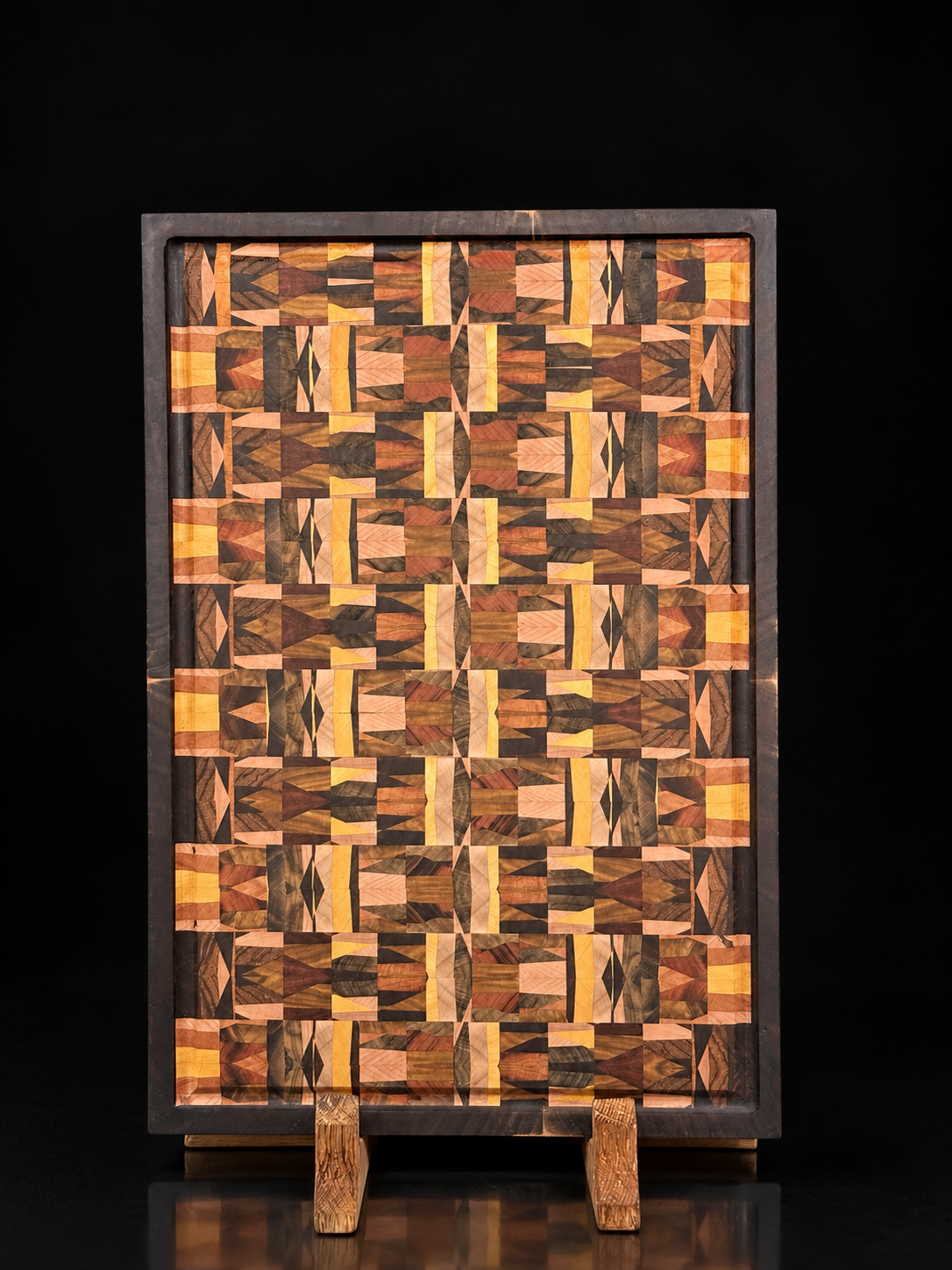
Close detail of mixed hardwoods in a Whiskey Oaks Handmade end-grain composition

Meet the wood

No paint. No printed grain. Those colors are real.

The material

Is the woodactuallythat color?

Yep.

The deep blacks, brilliant yellows, reds, purples, stripes and wild grain patterns in our work come from the wood itself. We work with domestic hardwoods and exotic species from around the world, choosing individual boards for their natural color, grain, figure and character.

And some of them are ridiculously hard.

A steel ball,pressed intoa board.

That is the whole test. Janka hardness measures the force needed to press a small steel ball halfway into a piece of wood. The answer is given in pounds-force, written lbf. A higher number means a harder wood — more force required, more resistance to denting and wear.

White oak, the wood under half the floors and kitchen tables in America, comes in around 1,360 lbf. Keep that number in your pocket. Everything below is measured against it.

Walnut sits well under it. Padauk sits comfortably above. African blackwood is nearly three times it, which is roughly when the tooling starts filing complaints.

The collection

Eighteen woods.No two alike.

African Blackwood

Extremely Hard
Origin
Central & East Africa — Tanzania, Mozambique
Janka hardness
≈ 3,670 lbf

Color. Deep black, occasionally with a faint purple or brown cast.

Grain. Extremely fine and even. The pores are so small the surface reads as stone rather than timber.

One of the densest woods in commercial use — dense enough to sink in water, and the traditional choice for clarinets and oboes.

With age. Darkens further with light, settling toward true black.
African Mahogany

Moderate
Origin
West & Central Africa
Janka hardness
≈ 1,070 lbf

Color. Pink-brown through to a deep reddish brown.

Grain. Interlocked, which throws a ribbon stripe that shifts as you walk past it.

Softer than most people expect from something that looks this regal. We use it where the ribbon figure does the work.

With age. Deepens and reddens with light.

Patagonian Rosewood

Extremely Hard
Origin
South America — Bolivia, Paraguay, northern Argentina
Janka hardness
≈ 3,600–3,840 lbf

Color. Red-brown to violet-brown, crossed with much darker streaks.

Grain. Wild and highly variable streaking — no two boards agree with each other.

Near the very top of the hardness scale. It blunts tooling with real enthusiasm.

A note on the name. A trade name, not a species. It is usually curupay (Anadenanthera colubrina or A. peregrina) and is not botanically a rosewood at all. Published hardness figures range from about 3,600 to 3,840 lbf depending on the source and the sample, so we quote the range rather than pretend to a single number.

Brazilian Ebony

Extremely Hard
Origin
South America — Brazil
Janka hardness
≈ 3,400–3,690 lbf

Color. Very dark brown to almost black, often with fine lighter lines.

Grain. Tight, straight, uniform — an ebony look without true ebony.

Exceptionally stiff. Some of the highest stiffness readings ever recorded in a timber come from this group.

A note on the name. Another trade name covering more than one botanical species, most often Swartzia (coração de negro). It is not related to true ebony. Some published figures are estimated from density rather than measured, so we give a range.

Black Limba

Moderate
Origin
West Africa
Janka hardness
≈ 990 lbf

Color. Pale golden through light brown, shot through with grey-black streaks.

Grain. Ranges from quietly plain to spectacularly figured — sometimes within one board.

Black limba and white limba come from the same tree. The dark streaking is the only difference, and it is the reason we buy it.

Bocote

Very Hard
Origin
Mexico & Central America
Janka hardness
≈ 2,010 lbf

Color. Golden tan to tobacco brown with near-black striping.

Grain. Dramatic swirling figure, frequently with eyes and knots that look drawn on.

Naturally oily, which gives it a polished sheen straight off the sander.

With age. Darkens over time, which softens the contrast between stripe and ground.

Canarywood

Hard
Origin
South America — Brazil, Peru, Bolivia
Janka hardness
≈ 1,520 lbf

Color. Pale yellow-orange through to deep red, usually streaked with both at once.

Grain. Mostly straight, with strong variegated color banding.

One of the most color-variable woods we work with. Two boards from the same tree can look unrelated.

With age. Darkens noticeably toward amber and red — the yellows warm up within months.

Cherry

Moderate
Origin
North America
Janka hardness
≈ 950 lbf

Color. Pale pinkish brown when fresh, warming to a deep reddish amber.

Grain. Fine, smooth and close, often with gum flecks and subtle waves.

The most dramatic color change of anything in the studio. A cherry piece you buy today will not be the color it is now in a year.

With age. Darkens and richens continuously with light. This is not fading — it is the wood maturing, and it is the main reason people choose it.

See this wood in our work

Cocobolo

Very Hard
Origin
Central America — Mexico through Panama
Janka hardness
≈ 2,960 lbf

Color. Orange and red ground with black and purple streaking.

Grain. Fine and dense, frequently wavy, with extraordinary depth under finish.

So naturally oily that it polishes to a shine with almost no help, and so dense it sinks.

With age. Deepens from bright orange-red toward a dark burgundy brown.

Curly Maple

Varies
Origin
North America
Janka hardness
Depends on the maple — roughly 950–1,450 lbf

Color. Creamy white to pale blond.

Grain. Rippling bands that appear to move as you walk past. The surface is flat; the figure is not.

The curl is caused by compressed, wavy fibre — light bounces off it at different angles, so the wood seems to shift and glow.

A note on the name. Curly is a figure, not a species. The hardness depends entirely on which maple it came from: soft maple sits near 950 lbf, hard maple near 1,450.

Figured Purpleheart

Very Hard
Origin
Central & South America
Janka hardness
≈ 2,520 lbf

Color. Purple. Genuinely, unmistakably purple.

Grain. Usually straight, and in figured boards rippled or quilted enough to pool the color.

Yes, it is actually purple. Freshly cut it is a dull grayish brown, then it oxidizes to vivid violet within days of meeting air.

With age. The bright purple matures toward a deep burgundy brown. A UV-blocking finish slows it considerably.

Hard Maple

Hard
Origin
North America
Janka hardness
≈ 1,450 lbf

Color. Creamy white to pale blond, with very little color variation.

Grain. Fine, tight, uniform and close — the quiet one in every board.

The traditional butcher-block wood, and the reason so many of our boards feel balanced: it gives the loud exotics something to be loud against.

With age. Warms slowly to a light honey tone.

Maple Burl

Varies
Origin
North America
Janka hardness
Depends on the maple — roughly 950–1,450 lbf

Color. Blond to warm amber, frequently with darker eyes and mineral staining.

Grain. Chaotic swirls, clustered eyes and no reliable direction at all.

A burl is a growth response — the tree reacting to stress or injury by producing a dense knot cluster. Difficult to work, impossible to repeat.

A note on the name. Like curly, burl describes how the wood grew rather than what species it is. Hardness follows the underlying maple.

Padauk

Hard
Origin
West & Central Africa
Janka hardness
≈ 1,725–1,970 lbf

Color. Brilliant orange-red, sometimes closer to true vermilion.

Grain. Open, fairly coarse, usually straight, with a natural glow under finish.

That color is the wood itself — no stain, no dye, nothing added. It is the single most common thing visitors refuse to believe.

With age. The fire-orange is temporary. Over months it oxidizes toward a deep reddish brown, and eventually a purple-brown. A UV-inhibiting finish slows it, but nothing stops it.

A note on the name. Published figures differ by source; the honest answer is a range.

See this wood in our work

Black Walnut

Moderate
Origin
North America
Janka hardness
≈ 1,010 lbf

Color. Chocolate brown, with purple, gray and occasionally green undertones.

Grain. Straight to gently waved, with crotch figure and live edges where the tree allows.

The studio workhorse. Not especially hard, exceptionally stable, and it carves and sculpts better than almost anything else we keep in stock.

With age. Unusually, walnut lightens rather than darkens — the deep brown mellows toward a warmer honeyed tone.

See this wood in our work

Wenge

Hard
Origin
Central Africa — the Congo basin
Janka hardness
≈ 1,630–1,930 lbf

Color. Very dark brown with near-black grain lines running through it.

Grain. Coarse and straight, with a pronounced splintery texture that has to be respected.

Naturally almost black. Where other makers reach for stain to get this color, we reach for a board.

With age. Darkens further, and the contrast between the brown and the black lines quietly closes up.

A note on the name. Sources disagree on the figure; the range is the honest answer.

Yellowheart

Hard
Origin
South America — Brazil
Janka hardness
≈ 1,790–1,880 lbf

Color. Vivid lemon to golden yellow.

Grain. Fine, even and usually straight, with a natural luster.

Yes, it is naturally yellow. Very few woods hold a true yellow, and fewer still hold it for decades.

With age. Deepens slightly toward gold, but it stays remarkably bright — this is not a color that gives up.

Zebrawood

Hard
Origin
West Africa — Gabon, Cameroon
Janka hardness
≈ 1,575–1,830 lbf

Color. Pale golden ground with bold dark brown to black stripes.

Grain. Interlocked and wavy, which is what produces the stripe in the first place.

Those stripes are completely natural. Quarter-sawn it gives sharp parallel bands; flat-sawn it goes wild and irregular.

With age. The pale ground warms to honey, which gradually softens the contrast.

See this wood in our work

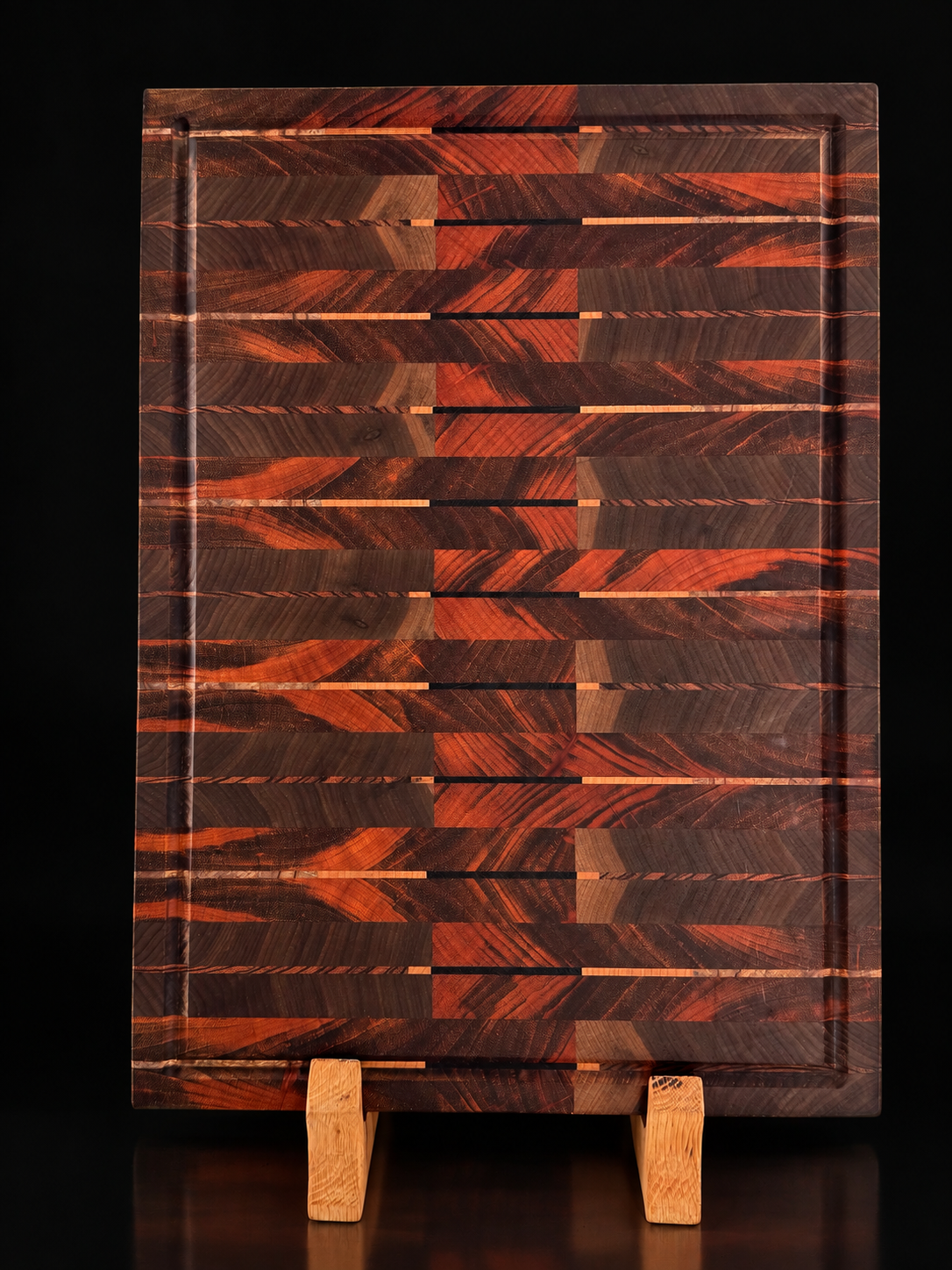
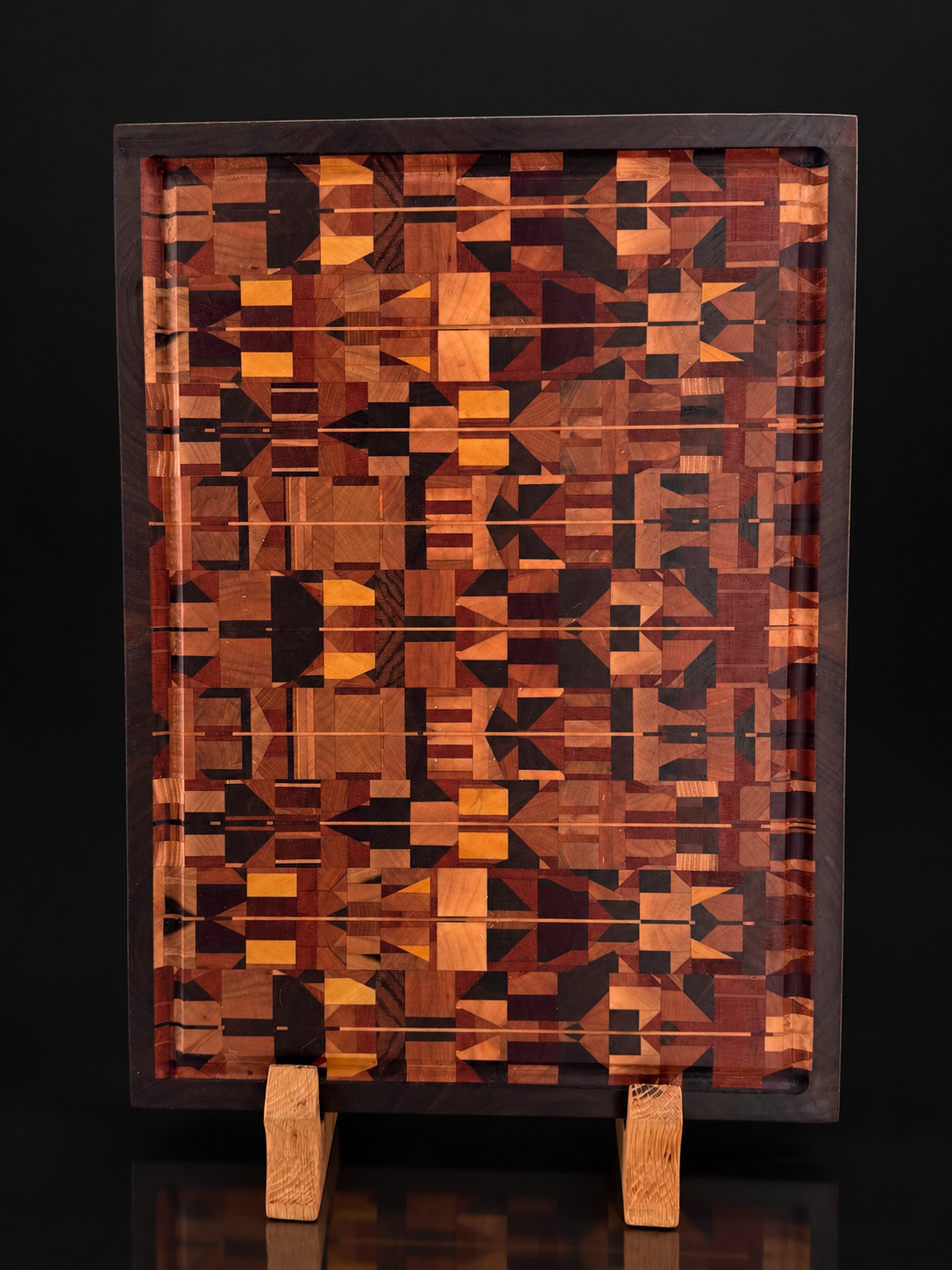
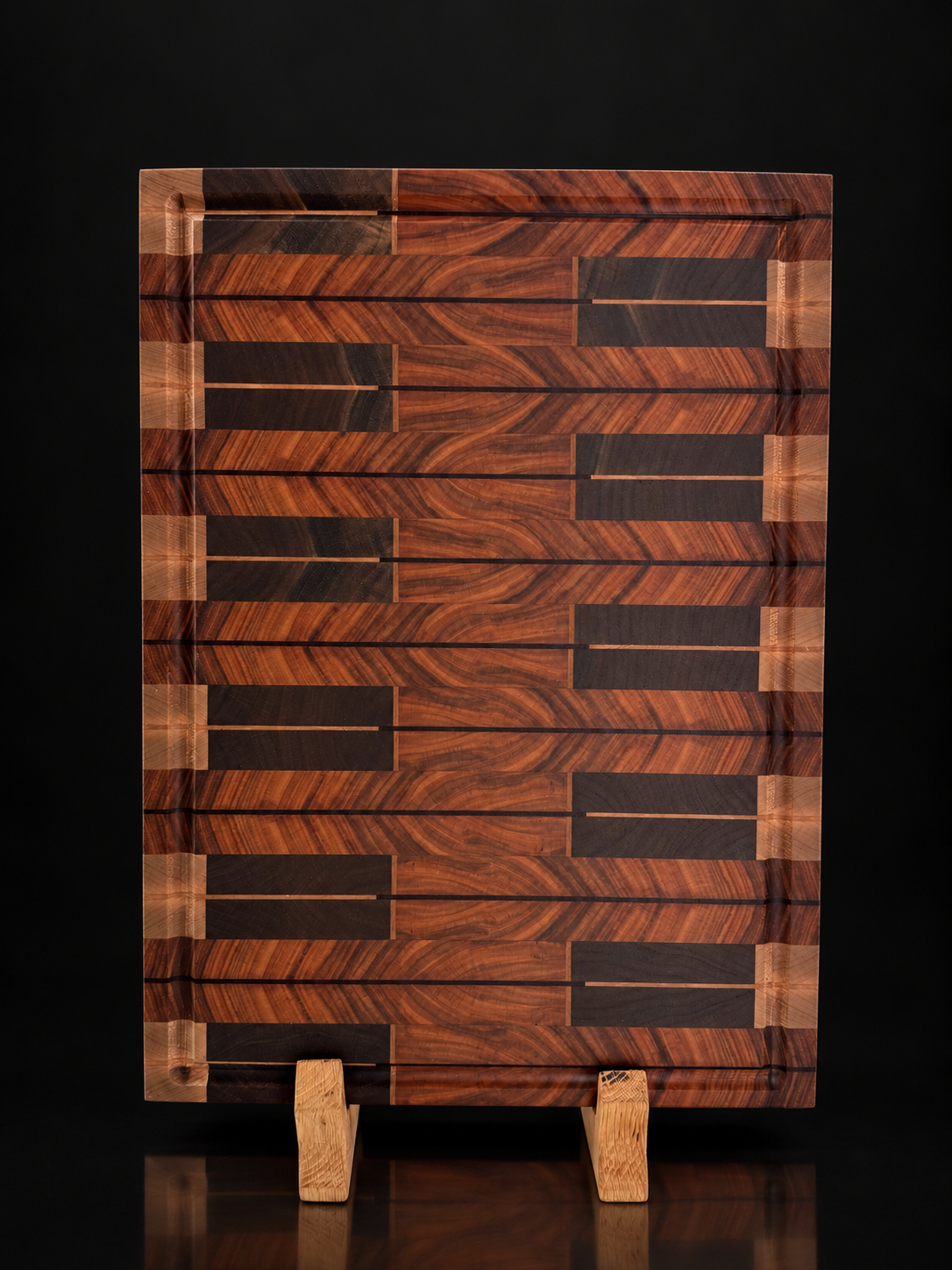
The colorsare real.

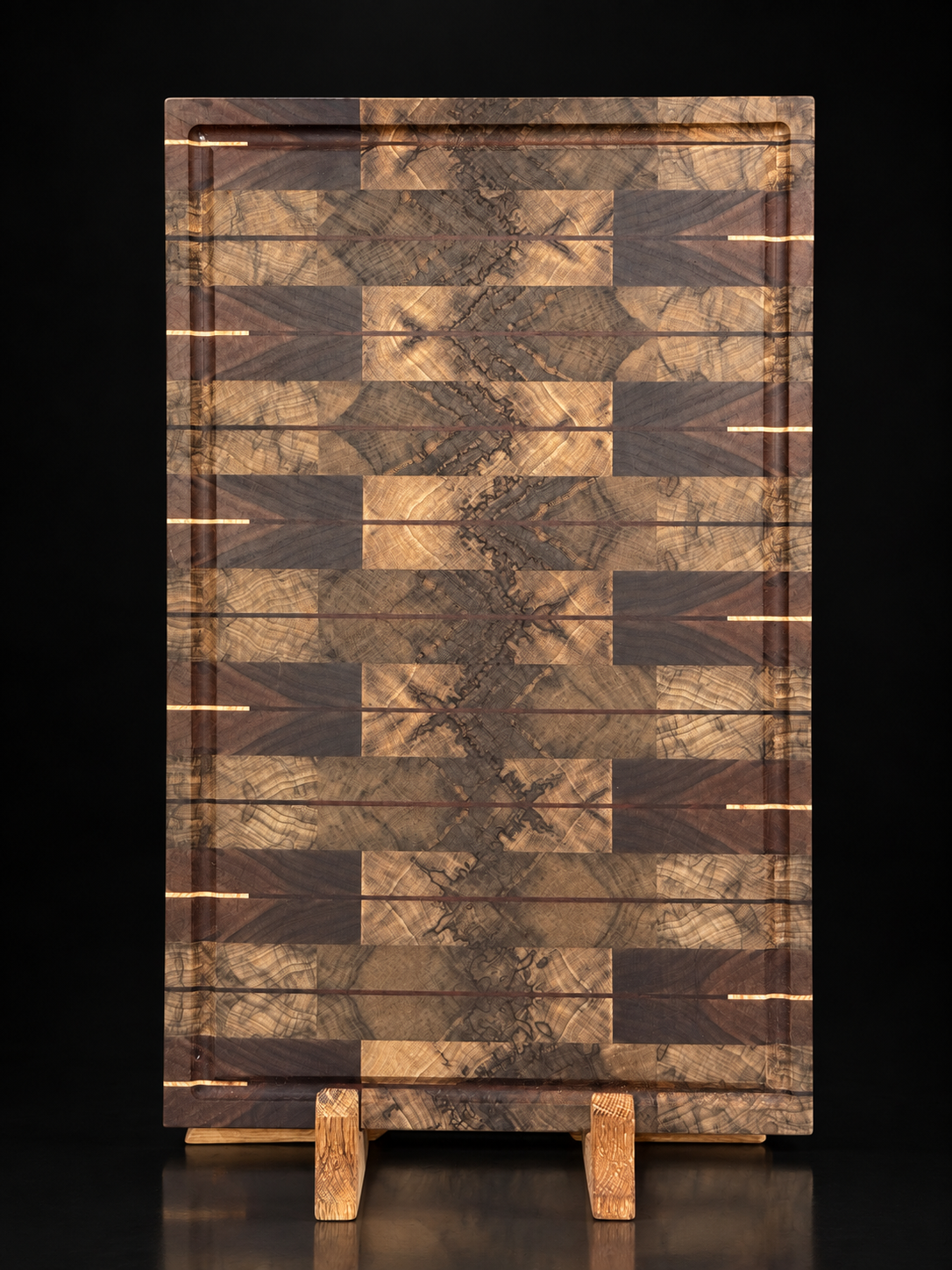
No painted-on grain. No artificial wood patterns. No trying to make every board look the same. Every color below grew that way.

Wild Vein end-grain board, natural hardwood color
Wild Vein
Firebreak end-grain board, natural hardwood color
Firebreak
Chaos 1 end-grain board, natural hardwood color
Chaos 1
Syncopation end-grain board, natural hardwood color
Syncopation

Softest toridiculous.

Harder is not better. It is simply one property among several. Grain, figure, color, stability, how the wood moves with the seasons and what the piece is meant to be all matter at least as much — a sculpture and a cutting board want different things entirely.

Softest to hardest

White oak ≈ 1,360 lbf marked throughout

  • Cherry

    ≈ 950 lbf
  • Black Limba

    ≈ 990 lbf
  • Black Walnut

    ≈ 1,010 lbf
  • African Mahogany

    ≈ 1,070 lbf
  • Curly Maple

    Depends on the maple — roughly 950–1,450 lbf
  • Maple Burl

    Depends on the maple — roughly 950–1,450 lbf
  • Hard Maple

    ≈ 1,450 lbf
  • Canarywood

    ≈ 1,520 lbf
  • Zebrawood

    ≈ 1,575–1,830 lbf
  • Wenge

    ≈ 1,630–1,930 lbf
  • Yellowheart

    ≈ 1,790–1,880 lbf
  • Padauk

    ≈ 1,725–1,970 lbf
  • Bocote

    ≈ 2,010 lbf
  • Figured Purpleheart

    ≈ 2,520 lbf
  • Cocobolo

    ≈ 2,960 lbf
  • Brazilian Ebony

    ≈ 3,400–3,690 lbf
  • African Blackwood

    ≈ 3,670 lbf
  • Patagonian Rosewood

    ≈ 3,600–3,840 lbf

Figures are approximate. Hardness varies between samples of the same species, and published sources do not always agree — where they disagree meaningfully, we show the range rather than invent a number.

Why no twopieces match.

Wood is not a manufactured material. It is the record of a tree that stood somewhere for decades, reacting to everything that happened to it.

These differences are not flaws. They are the reason the work is one of a kind.

  • 01

    Grain and figure

    Curl, quilt, burl and crotch figure are accidents of how a tree grew — stress, wind, a branch, an injury. They cannot be ordered and they cannot be repeated.

  • 02

    Knots and mineral streaks

    Minerals drawn up out of the soil leave dark lines through the wood. A knot is where a branch once was. Both are the tree keeping a record of its own life.

  • 03

    Heartwood and sapwood

    The pale outer sapwood and the darker inner heartwood are the same tree at two stages. Where we leave both in a piece, that line is the boundary.

  • 04

    Color

    Two boards milled from one log can differ in color. Light, age and the cut all move it. The piece you receive is the piece photographed, not a representative sample.

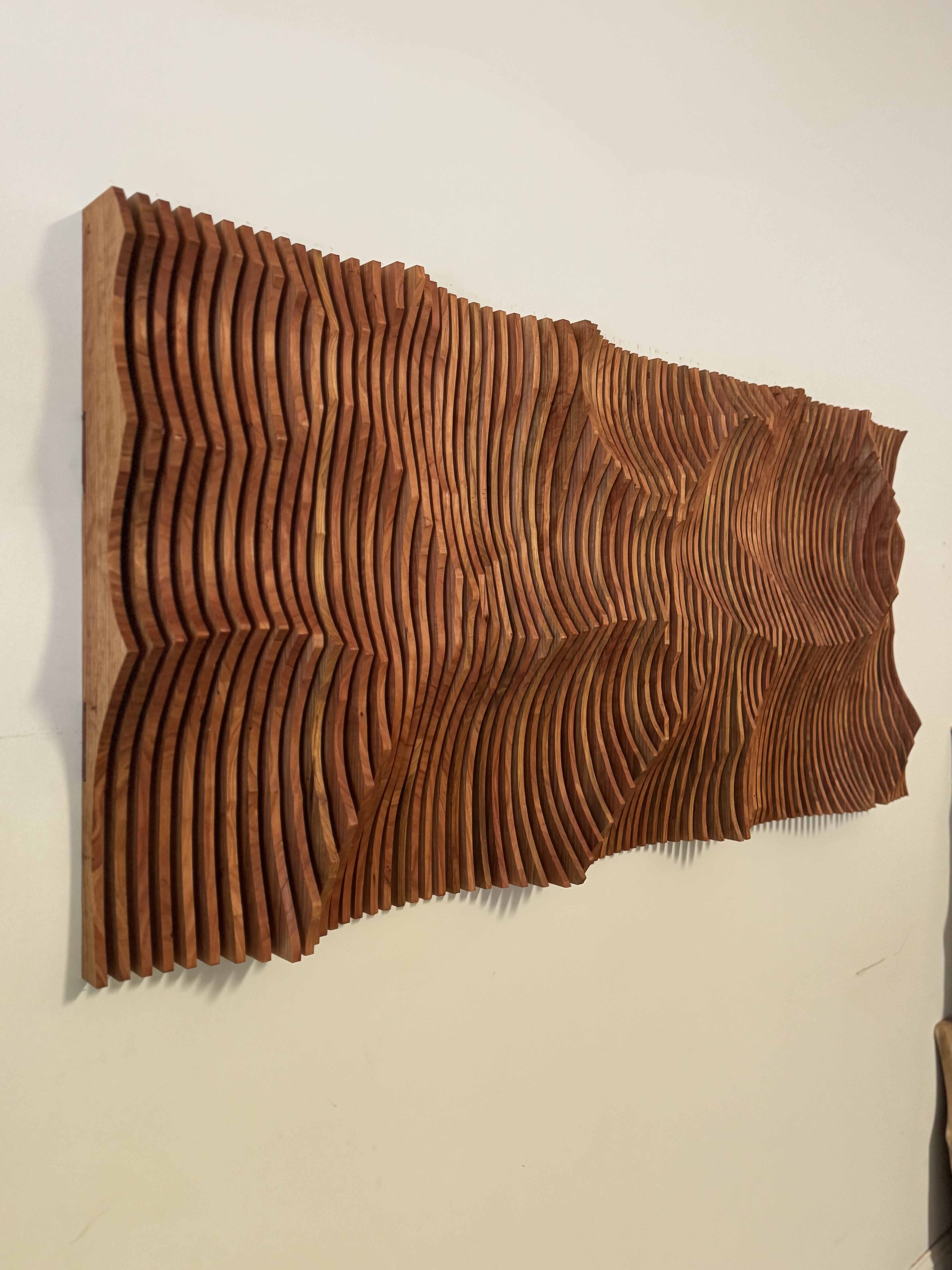
The Shape of Silence, a sculptural cherry wall piece by Whiskey Oaks Handmade

Now go andsee it in person.

Photographs get close. They do not quite get there — the depth in figured wood only really appears when you move in front of it.

Meet the Wood — Whiskey Oaks Handmade | My Store